Historical Attractions in Shenandoah County and Local Heritage
Historical places across Shenandoah County show how local life changed through war, farming, transport, government, and settlement. Historical attractions in Shenandoah County include battlefields, museums, an old courthouse, a covered bridge, farms, and preserved buildings. Together they give a clear view of regional history, from early settlement and agriculture to the Civil War and community life that followed.
Historical Attractions in Shenandoah County Connected With War
Cedar Creek and Belle Grove Plantation National Historical Park presents a much wider history of the Shenandoah Valley. The story begins before the Civil War, with Native American presence and later frontier settlement. The fertile valley developed into an important wheat–producing region. During the war, the same landscape became a battlefield. The Battle of Cedar Creek took place on October 19, 1864, and ended in a Union victory.
Fisher’s Hill Battlefield, in the Toms Brook and Strasburg area, is another place connected with the 1864 Shenandoah Valley Campaign. Visitors can see interpretive signs and wide views across the surrounding landscape. The location helps explain how geography influenced military movement and how open valley land became part of major wartime operations.
Hupp’s Hill Civil War Park and Visitor Center combines outdoor ground with museum interpretation. Walking trails pass Civil War earthworks, while indoor displays explain events in the Shenandoah Valley during 1864. The museum also gives attention to hardships faced by women and children who had to maintain homes while military actions continued nearby.
Medical Care and Local Residents
The story of war also includes medical care. A local historical brochure, Caring for the Wounded, records how temporary hospitals operated in Shenandoah County and how residents helped injured soldiers without regard to uniform. Diary quotations and accounts of food donations show how civilians supported hospitals even when food supplies were limited.
Museums, Buildings, and Historic Places
Historical attractions in Shenandoah County also preserve government, transport, agriculture, and domestic life. Some places continue to use structures that are more than two centuries old, while others turn former working buildings into museums.
The Shenandoah County Historic Courthouse in Woodstock was constructed in 1795 from native limestone. It is described as the oldest courthouse west of the Blue Ridge Mountains that remained in continuous use. During the Civil War, troops from both sides passed through the building and left graffiti on interior walls.
Changes to the courthouse continued after the war. A Greek Revival addition was built in 1871, clerk offices were added in 1886, and the front received columns and a portico in 1927. The old building later served as a visitor information center, courtroom museum, historical society office, community space, and place for occasional court use.
Museums Inside Historic Structures
The Shenandoah Valley Heritage Museum occupies the Edinburg Mill, built in 1848 by George Grandstaff. The building worked as a grist mill until 1978. It is notable because it was among the few valley mills not burned during Sheridan’s Civil War campaign. Museum features include agricultural displays, transport exhibits, recreated storefronts, and a film about the burning of the valley.
Strasburg Museum uses a former Southern Railway depot. Its collections include objects from the eighteenth, nineteenth, and twentieth centuries. Visitors can see Native American artifacts, Civil War objects, farm and household materials, a railway baggage car, Victorian–style rooms, and examples of Strasburg pottery.
Bridges, Farms, and Everyday Heritage
Meem’s Bottom Covered Bridge is one of the county’s best–known structures. The bridge is a 204–foot single–span Burr arch truss over the North Fork of the Shenandoah River. It was built in 1894 with local materials for its arch supports and stone abutments. The site had earlier bridges before the present structure was completed.
The bridge carried traffic for more than 80 years before vandals burned it on Halloween in 1976. Original timbers were saved, and the bridge was reconstructed. Later support included steel beams and concrete piers. Earlier crossings at the same location also faced destruction, including one burned in 1862 and another washed away by a flood in 1870.
Smith Creek Heritage Farm gives a different view of history through agricultural equipment and collectibles. The displays contain farm–related objects dating across centuries. The collection reflects how machinery, tools, and farming methods changed over time in a county where agriculture was long central to daily life.
- Cedar Creek and Belle Grove Plantation National Historical Park
- Fisher’s Hill Battlefield near Toms Brook and Strasburg
- Hupp’s Hill Civil War Park and Visitor Center
- Meem’s Bottom Covered Bridge
- Our Soldiers Cemetery in Mount Jackson
- Shenandoah County Historic Courthouse in Woodstock
- Shenandoah Valley Heritage Museum at Edinburg Mill
- Smith Creek Heritage Farm near New Market
- Strasburg Museum
- Virginia Museum of the Civil War and New Market Battlefield
- Woodstock Museum and its two historic houses
New Market and the Wider County Story
The Virginia Museum of the Civil War at New Market combines a museum, battlefield park, and historic farm. The museum gives attention to the Battle of New Market on May 15, 1864, including the participation of 257 Virginia Military Institute cadets. Of these cadets, 47 were wounded and 10 were killed.
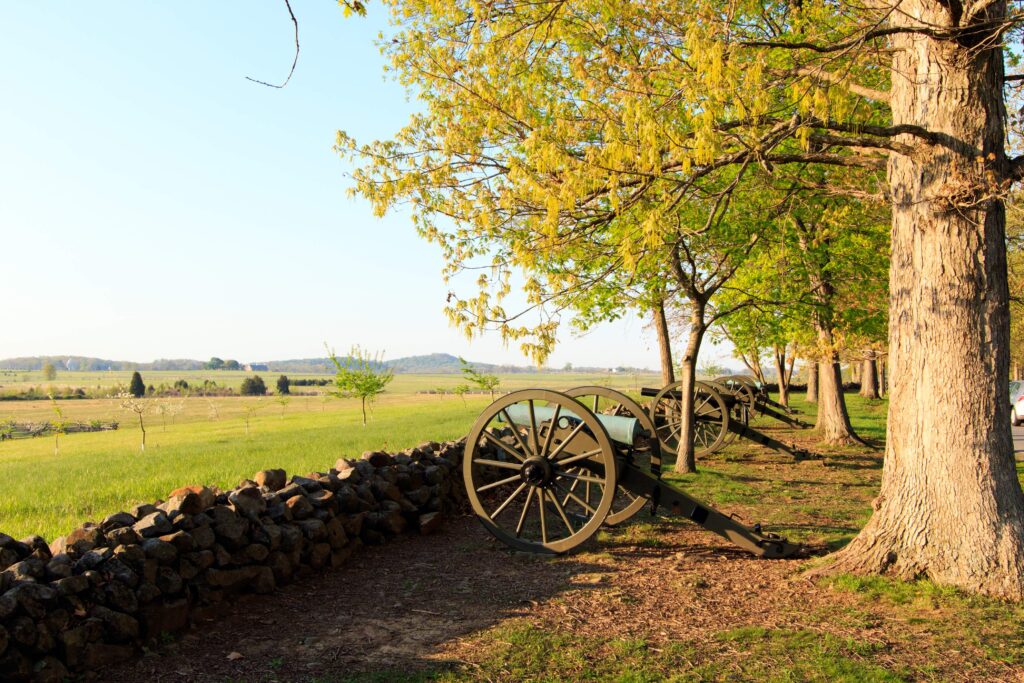
Outside the museum, around 300 acres of battlefield property can be explored by foot or car. Two walking trails cross the farm and battlefield and reach Bushong’s Hill. Visitors can also see places traditionally called the Field of Lost Shoes and the Fatal Orchard, both connected with events during the battle.
Historic Bushong Farm contains seven buildings. Two frame houses stood through the fighting, and exhibits inside explain life in the Shenandoah Valley before and during the war. This combination of preserved land, buildings, objects, and interpretation makes New Market a useful place for understanding military history together with civilian experience.